Shattered Syntax: Why American Writers Are Breaking the Sentence to Tell the Truth
There is a particular dishonesty embedded in the complete sentence. Subject, verb, object — a clean arc from intention to resolution, from wound to scar. For centuries, this architecture served as the default contract between writer and reader, promising that even the most harrowing experience could be organized into something legible, something survivable. Contemporary American literature is increasingly refusing that promise. Not out of carelessness, and not, as detractors insist, out of a fashionable obscurantism, but out of a rigorous fidelity to what experience actually feels like when it exceeds the capacity of grammar to contain it.
Fragmentation — the deliberate shattering of narrative coherence, syntactic order, and linear causality — has become one of the defining formal strategies of serious American fiction and poetry in the twenty-first century. It is not a new impulse. The modernist tradition gave us Faulkner's spiraling interior monologues, Dos Passos's collaged Newsreels, the radical white space of William Carlos Williams. But what distinguishes the current moment is neither the technique nor its frequency. It is the explicitness of the argument behind it: that disassembly is not a stylistic preference but a moral position.
The Grammar of Trauma
To understand why fragmentation has become so central to contemporary American writing, one must first reckon with what the intact sentence implicitly claims. A well-formed narrative asserts that events have causes, that time moves in one direction, that the self persists coherently from one moment to the next. For survivors of trauma — and American literature in the past two decades has increasingly centered those survivors — these assertions are not merely inaccurate. They are a form of violence.
Psychological research has long documented that traumatic memory does not behave like ordinary recollection. It does not arrange itself into story. It arrives in fragments: a smell, a texture, a sound stripped of its context, an image that intrudes without invitation. To render this experience in smooth, chronological prose is to falsify it — to impose a retrospective order that the psyche never actually achieved. Writers such as Claudia Rankine, Jenny Zhang, and Ocean Vuong have built their most significant work on this understanding. Their sentences do not break because the writers lack control. They break because control, in the face of certain experiences, would be a lie.
Vuong's On Earth We're Briefly Gorgeous constructs its letter-to-a-mother form around gaps that the prose never fills, absences that the reader must sit inside rather than pass through. Rankine's Citizen refuses the boundary between poetry and essay, between the personal and the political, between image and text, because the experience of racialized violence in America refuses those boundaries. The form is not illustrating the argument. The form is the argument.
Against Resolution
American literary culture has always maintained an uncomfortable relationship with irresolution. The publishing industry, responsive to market pressures that favor the legible and the consoling, has historically preferred narratives that arrive somewhere — at understanding, at grief processed into wisdom, at darkness that ultimately yields to light. The fragmented text resists this preference structurally. It cannot be summarized without being falsified. It cannot be resolved without being destroyed.
This resistance carries genuine philosophical weight. The philosopher Elaine Scarry argued in The Body in Pain that intense physical suffering actively destroys language — that pain, at its extremity, reduces the sufferer to a pre-linguistic state, to pure sensation without the cognitive architecture necessary for articulation. If Scarry is correct, then any literary form that claims to represent extreme suffering through fluent, ordered prose is engaged in a kind of retrospective fabrication. The fragmented text, by contrast, enacts the destruction of language from within language itself. It performs its own inadequacy as a form of testimony.
This is not a counsel of despair. It is, in fact, a deeply hopeful gesture — the insistence that honesty is still possible even at the limits of what words can do, that a broken sentence reaching toward something it cannot quite name is more truthful, and ultimately more companionable, than a perfect sentence that simply tells a comfortable story.
White Space as Argument
One of the most underexamined dimensions of American literary fragmentation is its use of physical space on the page. The white space surrounding a truncated line, the em dash that opens and does not close, the section break that arrives without warning — these are not decorative choices. They are load-bearing elements of meaning. They ask the reader to inhabit the silence rather than skip across it.
Poets working in this tradition — Layli Long Soldier, Solmaz Sharif, Paul Tran — have developed extraordinarily sophisticated grammars of interruption. Long Soldier's WHEREAS uses the formal language of government documents against itself, fracturing bureaucratic syntax to expose the violence concealed within it. Sharif's Look deploys the official terminology of the United States Department of Defense alongside intimate lyric address, the collision of those registers producing a kind of textual trembling that no unified voice could achieve. The page becomes a field of force rather than a surface of inscription.
For readers accustomed to consuming text as efficiently as possible — to extracting meaning and moving on — this demands a different kind of attention. It demands slowness. It demands a willingness to not understand immediately, to remain in a state of partial comprehension that mirrors the experience the text is attempting to evoke. This is not elitism. It is an invitation to a more honest mode of reading.
The Ethical Stakes
Critics of literary fragmentation often frame their objections in democratic terms: that deliberately difficult prose excludes readers, that it privileges the educated, that it mistakes obscurity for profundity. These objections deserve serious engagement. Difficulty that serves no purpose beyond the performance of difficulty is indeed a form of bad faith, and the American literary world has not been immune to that particular vanity.
But there is an equally important democratic argument on the other side. The insistence that all significant experience must be rendered in accessible, linear prose carries its own exclusions. It privileges the experiences that can be so rendered — those that have beginnings, middles, and ends, that move through crisis toward resolution, that can be told in a single, stable voice. It implicitly marginalizes experiences that do not conform to that shape, and the people whose lives are organized around those experiences.
When a writer chooses fragmentation to represent what fragmentation feels like from the inside, that writer is not abandoning the reader. That writer is refusing to abandon the experience. The distinction matters enormously.
The Dark House of Language
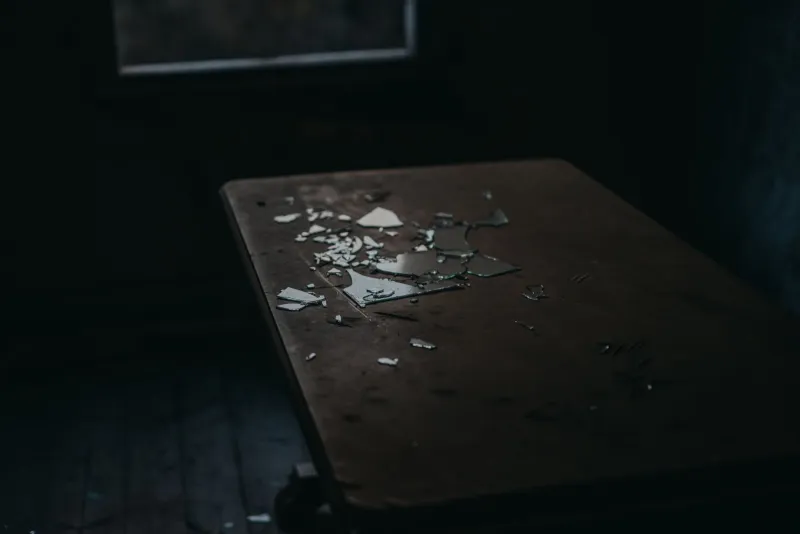
Literature has always been most alive at the point where it runs out of room — where the available forms press against the edges of what they can hold and begin, under that pressure, to crack. American writing is currently living in that productive crisis, and the writers who are doing the most honest work are those willing to let the crack show, to build their architecture around the break rather than papering over it.
The fragmented text is not a failure of craft. It is craft pushed to the frontier of its own possibility, where the sentence dissolves not into meaninglessness but into a different, more demanding kind of meaning. In the dark house of language, the rooms where the walls do not meet are often the ones most worth entering.