The Eloquence of Nothing: How American Publishers Learned to Fear the Pause

There is a particular kind of editorial note that has become distressingly common in American publishing acquisitions. It arrives, invariably, somewhere in the second or third round of revision feedback, and it reads, in various permutations, something like this: the pacing stalls here or readers may disengage at this section or, most revealingly, this passage doesn't do enough work. What the note rarely names — what it perhaps cannot afford to name — is the precise thing it is asking the writer to destroy: silence.
Not silence in the colloquial sense. Not quietude or understatement, which American literary culture has long permitted in carefully measured doses. Something more architecturally essential than that. The silence in question is the deliberate void — the narrative gap that does not resolve, the pause that asks the reader to remain suspended in uncertainty, the blank space between paragraphs that once functioned as a kind of negative space in which meaning was not delivered but discovered. This is the silence that contemporary publishing, in its accelerating anxiety about reader retention, has learned to treat as a defect.
It is worth understanding precisely what is being lost.
What Silence Once Did
The great experimental tradition in American fiction was, in substantial part, a literature of productive emptiness. Consider the structural lacunae in William Faulkner's novels, where narrative chronology fractures and the reader is deposited, without orientation, inside a consciousness that does not explain itself. Consider the white space that punctuates the work of Marilynne Robinson, where a sentence ends and what follows is not another sentence but an invitation to remain — to feel the weight of what has just been said before moving forward. Consider the radical incompleteness embedded in the late short fiction of Grace Paley, where stories conclude not with resolution but with the peculiar, vertiginous sensation of a door left open onto darkness.
These are not failures of craft. They are, in fact, among the most sophisticated achievements available to literary prose. The void, in such hands, becomes a structural argument: that experience does not cohere, that grief does not conclude, that the self is not a continuous narrative but something far more fractured and far less certain. To read literature that respects this reality is to be made temporarily homeless inside a text — and that homelessness, that productive disorientation, is precisely where literature does its most necessary work.
American publishers, responding to market signals that grow louder with each passing fiscal quarter, have increasingly decided that this work is a liability.
The Metrics of Engagement
The mechanisms driving this shift are not difficult to identify. The consolidation of American publishing into a small number of large corporate entities has imported, from adjacent entertainment industries, a set of assumptions about audience behavior that are fundamentally hostile to literary experience. Chief among these is the concept of engagement — a term borrowed from digital media analytics that measures, essentially, whether a consumer continues consuming.
Engagement, as a value, is not without its uses. But applied to literature, it performs a subtle and devastating substitution: it replaces the question of what a book means with the question of whether a reader continues. These are not the same question. In fact, they are frequently in direct opposition. The moments in literature most likely to produce genuine transformation — the moments that require a reader to stop, to sit inside discomfort, to resist the forward momentum of plot — are precisely the moments that engagement metrics flag as problems.
The result is a feedback loop with serious aesthetic consequences. Manuscripts are revised toward continuity. Narrative gaps are bridged. Pauses are filled with exposition, with action, with what editors sometimes call forward momentum — as though literature were a vehicle whose highest purpose is to arrive somewhere quickly, rather than a space in which the journey itself constitutes the meaning.
The Reader Presumed Incapable
Underlying this editorial philosophy is an assumption about American readers that deserves to be stated plainly, because it is both condescending and incorrect. The assumption is that the contemporary reader cannot tolerate discomfort — that an unresolved gap will produce not contemplation but abandonment, not depth but confusion. That the audience for serious American fiction must be protected, at all costs, from the experience of not knowing.
This is a profound misunderstanding of what draws readers to literature in the first place. The audiences who sustained the experimental traditions of the twentieth century — who read Toni Morrison's Beloved through its ghostly elisions, who followed the fractured chronology of Don DeLillo's Libra without demanding a cleaner map — were not a different species of reader. They were readers who had been trusted. They had been handed a text that presumed their capacity for difficulty, and they rose to meet it.
The contemporary publishing industry, in its commercial anxiety, has largely stopped trusting its audience. And in doing so, it has produced a literature that trusts no one — not the reader, not the writer, and certainly not the silence that once made both of them necessary to each other.
What Remains in the Filled-In Dark
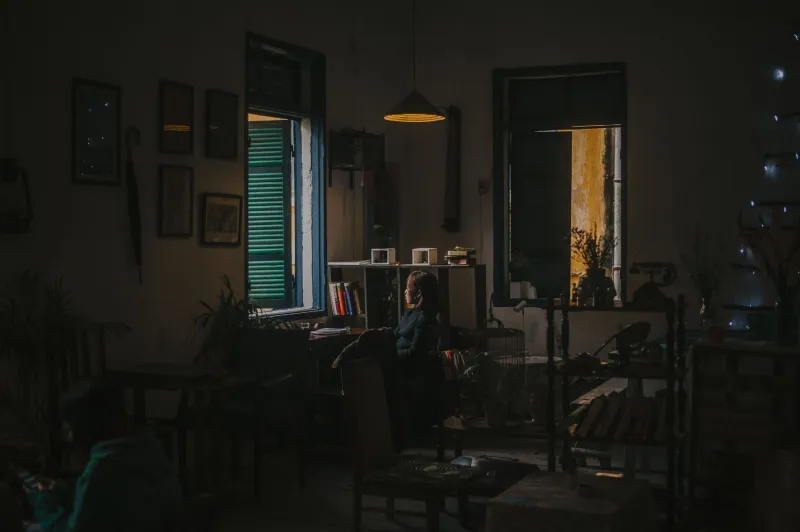
There is a useful architectural metaphor available here. In the design of certain buildings — and the dark house is perhaps the most resonant example — the negative space is not incidental to the structure. The corridor that ends without explanation, the room that exists on no blueprint, the threshold that opens onto nothing: these are not failures of planning. They are the building's unconscious, the place where its meaning accumulates in the absence of light.
Literature, at its most serious, operates by the same principle. The gaps are load-bearing. The silence holds up the walls.
When American publishers systematically eliminate those gaps in the name of engagement, they do not produce safer buildings. They produce structures that have lost their capacity to unsettle — which is to say, their capacity to mean anything at all beyond the surfaces they so efficiently present. The result is a literature that moves quickly and arrives nowhere that matters, a literature whose pages are full and whose silences have been paved over like inconvenient graves.
The writers who resist this pressure — who insist on the pause, who defend the unresolved gap, who refuse to fill every white space with the reassurance of forward motion — are not being difficult. They are being faithful to what literature, at its most essential, has always required: the willingness to sit inside emptiness long enough to learn what lives there.
American publishing would do well to remember that some of the most important things ever communicated between a writer and a reader were communicated in precisely that way — not through words, but through the charged and deliberate absence of them.