Ruin as Rhetoric: The Literary Journals Wearing Their Deterioration Proudly
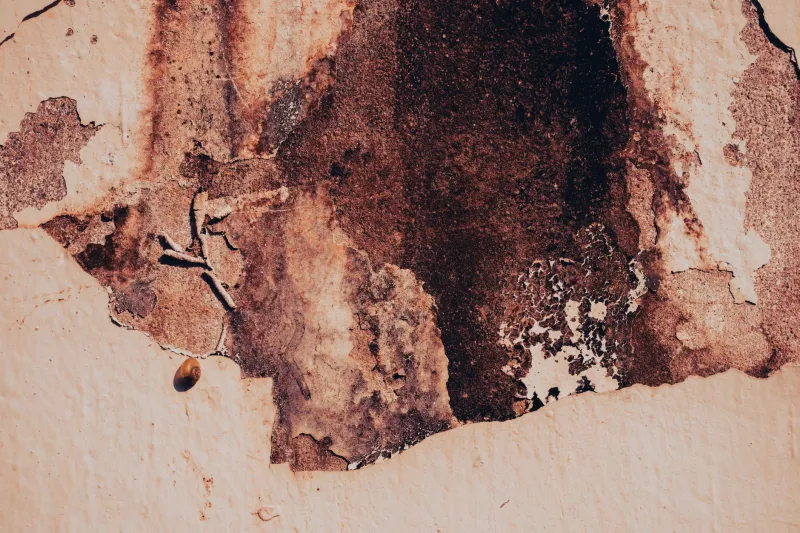
Pick up a copy of certain American literary journals and you will notice, before you read a single word, that something has gone wrong. The type bleeds at its edges. The paper carries the yellowish patina of age it has not yet earned. Images arrive halved, overexposed, or printed in registers that refuse to align. The whole object seems to be in the process of coming apart—and then you understand, slowly, that this is entirely intentional. The decay is the design. The ruin is the rhetoric.
This is not accident. It is a coherent aesthetic philosophy, and it has been quietly reshaping the visual language of American independent literary publishing for the better part of two decades.
The Object as Argument
To understand why deterioration has become a design language, it helps to consider what literary journals have traditionally communicated through their visual presentation. The clean, well-ordered journal—crisp fonts, generous white space, professional photography—makes an implicit claim about the work it contains: that literature is a stable, legible, civilized enterprise. The page is a guarantee of coherence.
The journals that have embraced aesthetic deterioration are making the opposite claim. They argue, through every smeared letterform and foxed margin, that literature is not stable, not legible in any simple sense, and certainly not comfortable. They insist that the physical experience of reading should mirror the thematic preoccupations of the work itself: loss, fragmentation, the unreliability of memory, the slow erosion of meaning under the pressure of time.
Publications like Dreginald, Diagram, and the various chapbook series emerging from small Midwestern and Southern presses have been particularly committed to this approach. Their design choices are not merely decorative—they are argumentative. The medium is not simply carrying the message; it is constituting it.
The Typewriter's Ghost
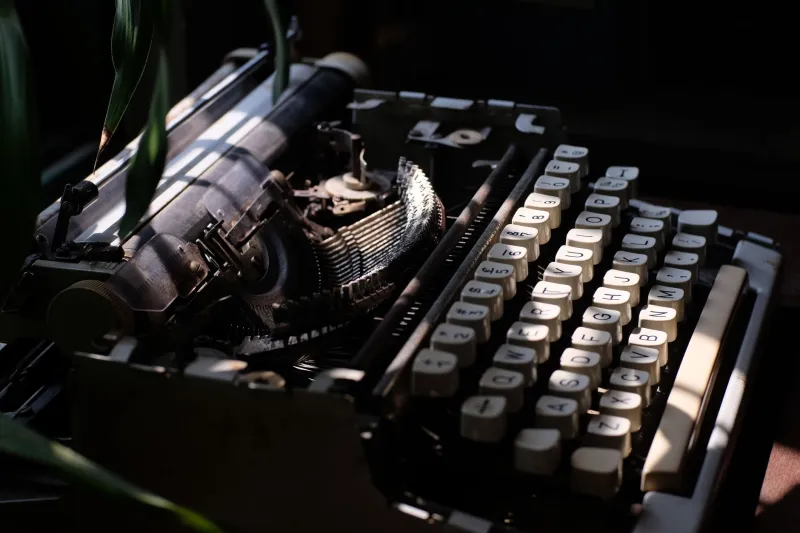
One of the most persistent visual motifs in this aesthetic is the ghost of analog technology—the typewriter key that strikes slightly off-center, the mimeograph bleed, the photocopier's characteristic flattening of depth. These are not nostalgic gestures, or not only nostalgic ones. They invoke a history of literary production that was always already imperfect, always already marked by the physical limitations of its tools.
The zine tradition is the obvious ancestor here. American zine culture, from its punk origins through its literary flowering in the 1990s, made a virtue of lo-fi production precisely because that roughness was legible as authenticity—as evidence that the object had been made by human hands rather than institutional machinery. The literary journals now working in this tradition have inherited that argument but refined it considerably. Where the zine's deterioration was often incidental, the product of limited resources, the contemporary literary journal's decay is curated. It has been achieved with considerable craft.
This paradox—the highly skilled production of the appearance of unskill—is central to understanding what these publications are doing. They are not simply failing to achieve cleanliness. They are working hard to produce a specific quality of damage.
Thematic Coherence
The most compelling examples of this aesthetic are those in which the visual deterioration is in genuine dialogue with the literary content. Consider the journals that publish work preoccupied with environmental collapse, with the erosion of cultural memory, with the experience of illness or grief. In these contexts, a page that appears to be dissolving is not merely a design choice—it is a form of editorial argument. The container is performing the same work as the contained.
This is, in a sense, the literary journal as total artwork. The German concept of Gesamtkunstwerk—the artwork that synthesizes all its elements into a unified aesthetic experience—has rarely been applied to the humble periodical, but it describes accurately what the most ambitious deterioration-aesthetic journals are attempting. They want the experience of holding the object to be inseparable from the experience of reading it.
The Brooklyn-based journal Fence has long played with the borders between visual art and literary publication. More recent arrivals, including various micro-press ventures operating out of Chicago, Portland, and the rural South, have pushed further into territory where the journal's physical condition becomes a primary expressive register. Some editions are printed on paper that will visibly age; some employ inks that fade; some incorporate found materials—newspaper clippings, bureaucratic forms, fragments of other texts—that bring their own histories of wear into the composition.
Against Preservation
There is a political dimension to this aesthetic that deserves acknowledgment. The well-preserved literary journal, archived in university libraries and digitized for perpetual access, participates in a cultural economy of canon-formation and institutional legitimacy. It aspires to permanence. It asks to be kept.
The deteriorating journal refuses this aspiration. By building obsolescence into its design, it resists the archival impulse and the hierarchies that impulse sustains. It insists on its own temporality—on the fact that literature, like everything else, exists in time and is subject to time's depredations. This is not nihilism. It is a form of honesty about what literary objects actually are: contingent, perishable, made under specific material conditions that will not last.
In a cultural moment when so much energy is devoted to questions of what gets preserved and who controls that preservation, the journal that wears its decay as a badge is making a quietly radical argument. It is saying that impermanence is not a failure but a condition, and that literature which acknowledges its own fragility may be telling a more truthful story than literature that pretends to transcend it.
Reading the Ruin
To read a journal committed to aesthetic deterioration is to experience a particular kind of double attention. You read the words, but you also read the damage—the way the ink has bled into the paper's grain, the way the image has been cropped to its most disorienting fragment, the way the typography has been distressed to suggest that these letters have survived something. You are always aware of the object in your hands, always conscious that what you hold is mortal.
This awareness is, finally, what these publications are after. They want to break the trance of transparent reading—the comfortable illusion that the page is simply a window onto meaning—and replace it with something more demanding and more honest. They want you to feel the weight of the thing, the texture of its surface, the evidence of its making and its unmaking.
In doing so, they return literature to its material origins. Before the book was an idea, it was an object. Before the text was a transmission, it was a mark made on a surface by a hand. The journals that embrace deterioration as design have not forgotten this. They have built their entire aesthetic around the refusal to let you forget it either.