Misspelled on Purpose: The Radical Grammar of Literary Defiance
There is a particular kind of violence that happens quietly, in the back rooms of publishing houses, where editorial hands smooth away the roughness of a writer's voice in the name of consistency. A comma relocated here. An unconventional spelling corrected there. A sentence restructured until it no longer sounds like the person who wrote it. For much of American literary history, this process has been treated as a courtesy — a refinement, a gift. A growing number of writers are now naming it for what it also is: erasure.
Across the contemporary American literary landscape, a loosely affiliated movement of poets, novelists, and experimental writers is choosing to leave the errors in. Not out of negligence, but out of conviction. The deliberate typo, the intentional grammatical rupture, the misspelling held firm against editorial pressure — these are becoming instruments of a quiet but consequential defiance.
The Error as Argument
To understand why a writer might insist on keeping a misspelling, one must first understand what standardized language actually standardizes. English spelling and grammar conventions were not handed down from some neutral authority. They were codified largely by white, educated, male institutions over centuries, and the "errors" they most aggressively corrected have often been the linguistic signatures of Black Americans, working-class writers, immigrants, neurodivergent authors, and regional voices whose relationship to the English language was shaped by experiences the style guides never accounted for.
When a writer chooses to publish with their idiosyncrasies intact — the doubled vowel that reflects a dialect, the absent apostrophe that mirrors how the word actually lives in their mind — they are not failing to meet a standard. They are refusing one. The error becomes an argument about who the standard was built to serve.
This is not an entirely new phenomenon. Zora Neale Hurston's decision to render African American vernacular speech with phonetic authenticity in Their Eyes Were Watching God was met with hostility from some contemporaries who felt it reinforced stereotypes. Hurston understood, ahead of her critics, that the alternative — a cleaned-up, standardized rendering — would have been the greater betrayal. The error, in her hands, was the truth.
Contemporary Practitioners of the Broken Letter
What distinguishes the current moment is the self-consciousness with which writers are deploying these strategies, and the theoretical frameworks they bring to the practice. Poets working in the tradition of Language writing and its descendants have long been interested in the materiality of the letter on the page — the way a word's visual form carries meaning independent of its semantic content. But newer practitioners are less interested in abstraction and more interested in the political body of the text.
Some writers are embedding misspellings that correspond to documented features of dyslexic cognition, insisting that their neurodivergent relationship to language is not a deficit to be corrected but a perspective to be honored. Others are preserving the grammatical structures of their first languages within English-language texts, creating a deliberate friction that refuses the reader the comfort of seamless assimilation. Still others are using typographical chaos — irregular spacing, unconventional capitalization, characters that seem to have wandered from their intended positions — to enact on the page the disorientation they experience in the world.
The small press ecosystem has proven far more hospitable to these experiments than the major houses. Presses operating outside the commercial mainstream are less beholden to the market logics that demand clean, easily digestible prose, and more willing to trust that a reader capable of sitting with difficulty will find something worth finding on the other side of it.
The Politics of Correction
There is a phrase that circulates among writers who have experienced aggressive copyediting: "house style." Every major publication and press has one — a set of preferences about how language should behave within its pages. House style is presented as neutral, as professional, as simply the way things are done. But house style is never neutral. It reflects the aesthetic and cultural preferences of the institution that created it, and those institutions have historically reflected a very narrow slice of American experience.
When a writer from outside that slice submits work that carries the marks of their particular relationship to language, the editorial process often functions as a kind of assimilation pressure. The manuscript that emerges from the other side may be more "correct," but it may also be less true. The voice that was the entire point of the work may have been quietly excised in the name of readability.
This is the grievance that the deliberate-error movement is articulating, and it is a serious one. The argument is not that all errors are equally valuable, or that craft is irrelevant. It is that the line between error and style, between mistake and method, is drawn by people with the power to draw lines — and that power has consequences.
Reading in the Dark
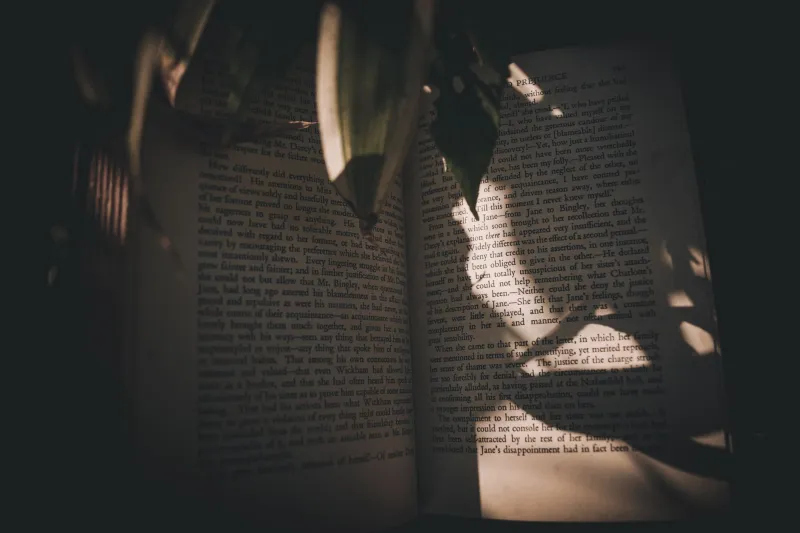
For readers trained to expect polished surfaces, encountering a text that wears its imperfections openly can produce a genuine unease. The eye catches on the wrong letter. The mind stumbles. There is a brief, disorienting moment in which the reader is not sure whether they are looking at a mistake or a decision.
That moment of uncertainty is precisely the point. It interrupts the passive consumption of text and forces an active engagement. The reader must decide: do I correct this in my head and read on, or do I sit with it, let it be what it is, and ask what it might mean? The first choice is comfortable. The second is where the literature actually lives.
The dark house of language has many rooms that standard usage has never bothered to illuminate. The writers who are leaving their errors in are not lost in those rooms. They are lighting matches.