Ink Against Empire: The Independent American Presses Rebuilding Literature from the Ground Up
The consolidation of American publishing into a handful of corporate entities—a process accelerated by the Penguin Random House era and further compressed by the failed merger that antitrust regulators blocked in 2022—has produced, as its most unexpected consequence, a proliferation of small presses operating with a freedom that the major houses have long since traded away. When the gatekeepers concentrate their power, the gates themselves become less relevant. New doors open in the walls the institutions forgot to watch.
This is the paradox at the heart of American independent publishing in the current decade: the very conditions that appear most hostile to literary diversity have generated the most fertile environment for literary experimentation in a generation. Across the country, in cities and small towns alike, micro-presses, chapbook publishers, and digital-first imprints are producing work of startling ambition—work that the commercial market would not touch, work that the MFA-industrial complex would not recognize, work that the literary establishment would not know how to evaluate even if it bothered to look.
What Independence Actually Means
The word independent in publishing has been stretched to near meaninglessness by decades of marketing appropriation. Imprints nominally independent but owned by Hachette, subsidiaries of subsidiaries with artisanal branding and corporate balance sheets—these are not what we are discussing here. True independence, in the context of the American small press, means something more demanding and more interesting.
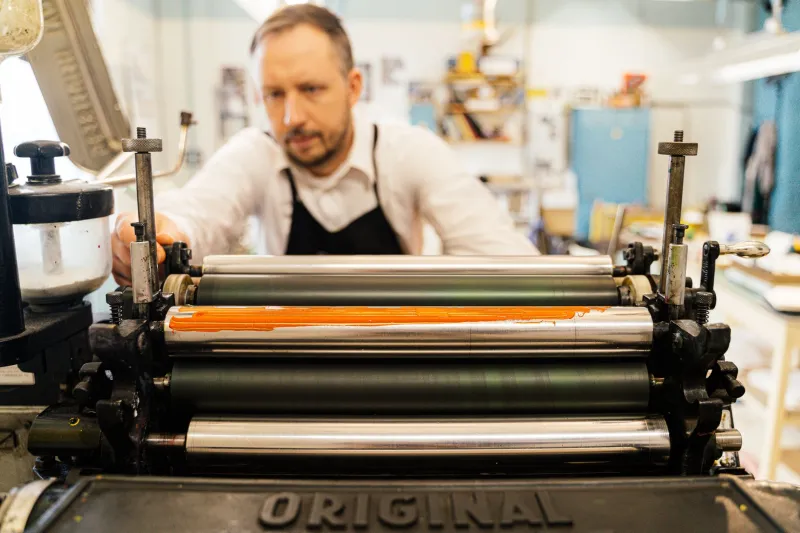
It means editorial decisions made without reference to sales projections. It means print runs of two hundred copies distributed through a network of relationships rather than algorithms. It means a publisher who is also the editor, the designer, the shipping department, and the person who hand-stamps the colophon at midnight because the aesthetic demands it. It means, in many cases, financial loss absorbed as the cost of artistic integrity—a calculation that no shareholder would approve and that no serious literary press can afford to abandon.
The presses operating in this territory include names that circulate primarily among the devoted: Rescue Press in Chicago, publishing formally adventurous fiction and poetry with a design sensibility that treats the book as an object worthy of the ideas it contains. Ugly Duckling Presse in Brooklyn, producing hand-sewn chapbooks and translations that arrive looking like artifacts from a parallel literary universe. Nightboat Books, committed to experimental and cross-genre work by writers whose relationship to identity and form refuses easy categorization. These are not boutique operations satisfying a niche market. They are the primary sites of American literary innovation.
The Chapbook as Revolutionary Form
No format has proven more central to the independent press revival than the chapbook—that ancient, stubbornly modest form that predates the modern publishing industry by centuries and has outlasted every attempt to render it obsolete. The chapbook's brevity is not a limitation. It is a discipline, and in the hands of contemporary American poets and prose writers, it has become a vehicle for work that the full-length collection or novel would inevitably dilute.
The economics of the chapbook are, paradoxically, its greatest asset. A press can produce a chapbook for a fraction of the cost of a full-length book, sell it at an accessible price point, and distribute it through readings, literary festivals, and direct mail to readers who have opted into a relationship of genuine attention. The transaction is intimate in a way that the commercial book market has entirely forgotten how to be.
Presses like Sarabande Books in Louisville, Kentucky, and Black Ocean in Boston have understood that the chapbook is not a lesser form awaiting promotion to full-length status. It is a complete form with its own requirements and its own possibilities—and those possibilities include a directness, a compression, and a willingness to take formal risks that longer works cannot always sustain.
Digital Disruption as Liberation
The relationship between independent American presses and digital publishing is more complicated than the standard narrative of technological disruption allows. The major houses approached digital formats primarily as a distribution mechanism—a new channel for the same content, priced to protect physical sales. The independent press community has approached digital publishing as a formal question: what does it mean to make a book that exists natively in this medium, that uses the medium's specific properties as part of its literary argument?
Presses like Dorothy, A Publishing Project have maintained a commitment to physical books even as they experiment with digital presence, understanding that the physicality of the object is part of what the reader is encountering. Others, including various digital-first imprints operating through platforms like Substack and dedicated web publishing tools, have embraced the screen as a primary site of literary encounter—not a compromise but a choice, with its own aesthetic implications.
What unites these divergent approaches is a shared refusal to let format decisions be made by market logic alone. The independent press asks, first and always: what does this work need in order to be fully itself? The answer determines the format, not the reverse.
Who Gets Published, and Why It Matters
The most consequential difference between the major houses and the American independent press community is not aesthetic but ethical. The commercial publishing industry, despite its rhetorical commitments to diversity, operates selection processes that systematically advantage writers whose work is legible to a particular demographic of acquiring editors, whose subject matter maps onto existing market categories, and whose platforms are already large enough to suggest a built-in audience.
The independent press, freed from these commercial constraints, has consistently published writers who fall outside these categories—not as a form of charitable inclusion but because the work demands it. The result is a body of American literature produced at the independent level that is more formally diverse, more demographically representative, and more willing to engage with difficulty in all its forms than anything the commercial market consistently produces.
This is not a claim that every small press is a paragon of progressive editorial practice. The independent sector has its own hierarchies, its own exclusions, its own aesthetic orthodoxies that can calcify into gatekeeping of a different kind. But the structural conditions of independence—the absence of shareholder pressure, the intimacy of editorial relationships, the freedom to publish at a loss in the service of a vision—create the possibility of a different kind of literary culture.
The Future Belongs to the Unglamorous
The independent American press revival is not a glamorous phenomenon. It does not announce itself in the pages of mainstream literary magazines or generate the kind of coverage that a major debut from a Big Five imprint reliably attracts. It operates, by necessity and often by choice, in the margins—in the back rooms of independent bookstores, at tables in university hallways, through mailing lists that reach hundreds rather than thousands.
This is precisely why it matters. The history of American literary innovation is, at its core, a history of work that happened where the establishment was not looking—work that found its readers through networks of passionate attention rather than marketing campaigns, that endured because it was necessary rather than because it was profitable.
The presses operating in this space today are not waiting for institutional recognition. They have understood, with a clarity that the major houses have lost, that literature's future belongs not to those who control the largest platforms but to those with the deepest commitment to the work itself—to the writers, the editors, the designers, and the readers who believe that a book can still be a radical act.