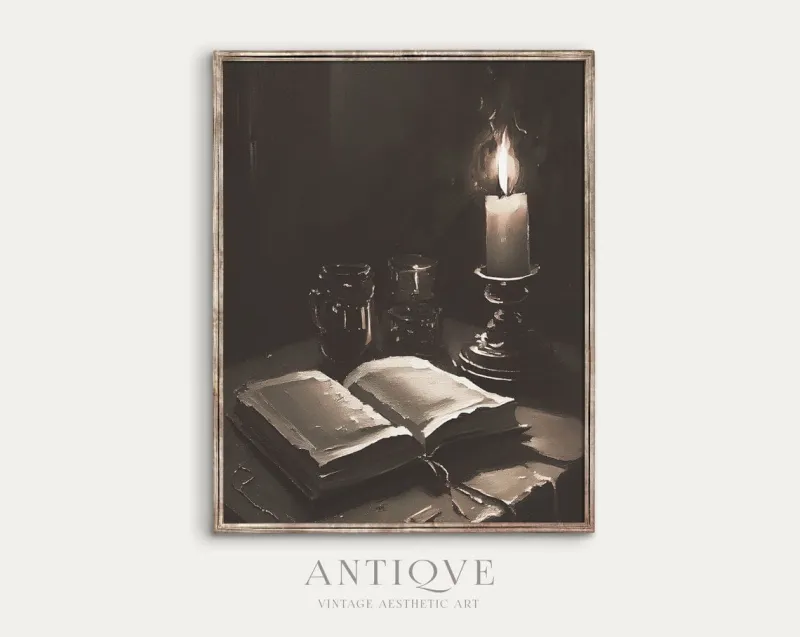
What the Page Withholds: The Art of Literary Silence in American Writing
Photo: Jeremy Bolwell, CC BY-SA 2.0, via Wikimedia Commons
Begin with the white space.
Before a single word is read, the page has already spoken. The margins, the gaps between stanzas, the line break that arrives before a thought completes itself — these are not the absence of language. They are language in its most concentrated form, stripped of the obligation to explain.
American writers have long understood that silence is not the opposite of expression. It is expression's most radical mode.
The Architecture of What Is Missing
Consider what Cormac McCarthy withholds in The Road. The novel never names its catastrophe. The event that has scorched the world, turned the sky to ash, and reduced civilization to predation and memory is never identified, never explained, never mourned in the explicit terms one might expect from an apocalyptic narrative. That silence is load-bearing. By refusing to name the disaster, McCarthy refuses to contain it — the unnamed catastrophe becomes every catastrophe, every failure of the human project, every way in which we have always been capable of destroying what we love. The gap where explanation should be is more terrifying than any explanation could have been.
This is the fundamental paradox of literary silence: what a text refuses to say can carry more weight than anything it commits to the page. The omission becomes a kind of gravitational field, pulling meaning toward it from every surrounding sentence.
Toni Morrison understood this with devastating precision. In Beloved, the central trauma — the act that Sethe commits to protect her daughter from slavery — is circled, approached, retreated from, and approached again across hundreds of pages before the reader is permitted to fully apprehend it. Morrison does not withhold this information to be coy or to manufacture suspense. She withholds it because she understands that some violences cannot be approached directly without being diminished. The silence around Sethe's act is a form of respect — for the horror itself, for the impossible moral calculus it represents, for the history of Black American suffering that it concentrates.
The White Space as Voice
In poetry, silence becomes visible. The line break is perhaps the most powerful formal tool available to the American poet — a controlled breath, a hesitation, a pivot that forces the reader to pause in the space between one meaning and another.
Louise Glück has made her career in that space. Her poems characteristically arrive in short, declarative lines that feel like statements of absolute certainty — and then break in ways that open sudden chasms of uncertainty beneath them. The white space in a Glück poem is not decorative. It is where the argument actually lives, where the emotional reckoning takes place in silence because language has reached its limit.
Langston Hughes, decades earlier, deployed white space with equal deliberateness. The spare, blues-inflected lines of his poetry carry within their brevity the weight of everything American culture refused to say about Black life — the griefs that could not be spoken aloud in polite company, the joys that were not supposed to exist, the full humanity that the dominant culture was determined to deny. Hughes's silences are political silences, the gaps left by a society that withheld language from the people it oppressed.
Unfinished Sentences and the Ethics of Omission
The dash — that most American of punctuation marks, as Emily Dickinson made it — is a technology of productive incompletion. Dickinson's dashes do not merely pause; they suggest that the poem is always in the process of saying something it cannot quite reach, that meaning exists just beyond the boundary of what language can accomplish. Her poems feel unfinished because finishedness would be a lie. The dash holds the door open on the infinite.
Contemporary American poets have inherited this tradition. Claudia Rankine's Citizen uses fragmentation, white space, and strategic omission to render the experience of racial microaggression — a form of violence that is itself characterized by what is left unsaid, by the plausible deniability built into every slight. The poem's silences enact the experience they describe: the moment after the offense, the held breath, the calculation of whether to speak or absorb. Rankine's white space is where that calculation happens, where the reader is forced to sit in the discomfort of an unresolved encounter.
Lydia Davis, working in the borderland between short fiction and prose poetry, has refined omission into a philosophical practice. Her shortest pieces — some no longer than a sentence or two — derive their power entirely from what they do not include. A Davis story about a marriage contains no marriage; a Davis story about grief contains no grief in any representational sense. What remains after her radical pruning is the essential shape of the thing, like an X-ray that shows the skeleton without the flesh.
Silence and the Unspeakable
There are silences in American literature that are not formal choices but moral necessities — the recognition that certain experiences resist language not because language is insufficient in some abstract sense, but because the act of narrating them too fluently would constitute a kind of violation.
Paul Celan's influence on American poetry — particularly on the work of writers engaging with historical trauma — has been precisely in this register. His famous statement that poetry after Auschwitz must speak in a language broken by what it witnessed has shaped how American poets have approached the representation of atrocity, from the Holocaust to slavery to the ongoing catastrophes of the present. To write about the unspeakable in clean, confident prose is to suggest that it is, in fact, speakable — and that suggestion is its own form of dishonesty.
Silence, in this light, is not evasion. It is precision.
The Deepest Room
The dark house of literature has always had a room that remains locked. The greatest American writers have known better than to force it open. They circle it, press their ear to the door, describe the quality of light that seeps beneath it — and in doing so, make the reader more aware of what lies behind that door than any direct description could achieve.
What a text withholds is never simply missing. It is present in the quality of the surrounding words, in the shape of the narrative space around it, in the particular kind of attention the writer directs elsewhere. Silence, handled with mastery, does not leave the page empty. It fills the page with everything that language, at its limit, cannot hold.
The writers who understand this — who have made a discipline of restraint, an art of the unsaid — are the ones whose work endures in the way that only the genuinely true endures: not by explaining the world, but by leaving within the reader a space where the world can be felt.